
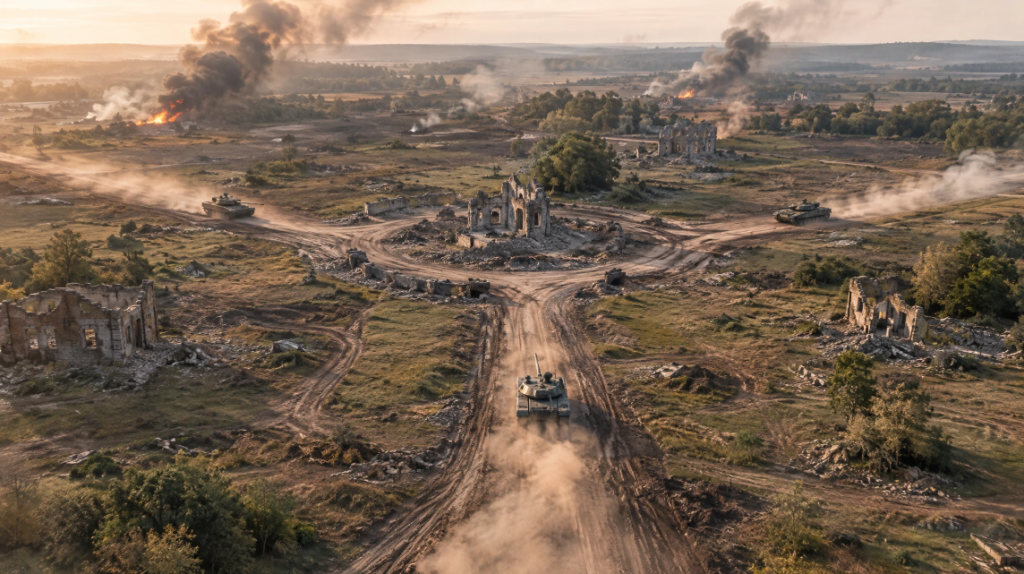
Predicting enemy moves in War Thunder works like reading a football fixture. Spot the pattern, adjust when new information lands, and act before the other side makes its move.
The player pool is huge. Steam Charts showed 52,847 concurrent players averaged over 30 days and a 108,197 peak, as of 11 November 2026. That’s a lot of opponents repeating the same habits.
These seven tips turn those habits into a battle plan. A better win rate and a healthier K/D ratio follow.
Tip 1: Read the Map and Spawn Patterns Before Contact
Most ground maps split into three lanes: a route to the nearest capture zone, a central route with direct fire, and a slower flank with better side-shot angles.
Fast vehicles usually reach a contested capture zone in roughly one to three minutes. Heavy tanks arrive later. Treat that as a tactical estimate, not a published average.
On open maps like Kursk, Sinai, and Fulda Gap, enemy markers and tracer fire show whether the other team committed to the center. On urban maps like Advance to the Rhine, the first intersection decides everything.
Think formation reading. The first visible vehicles aren’t the whole attack, so track the missing ones. Solid map knowledge plus these war thunder tips beats shortcuts like War Thunder cheats with aimbot and radar, which skip the game sense entirely.
Tip 2: Know Your Battle Rating Bracket and the 2026 Meta
Enemy behavior shifts with every battle rating bracket. Read the bracket first, then the player.
Low, mid, and top BR
Low BR tanks have visible armor weaknesses, slow turrets, and limited optics. Predict spawn routes and watch reload time: an enemy who just fired is a free peek.
Mid BR adds stabilizers, better ammunition, faster aircraft, and early close air support. Expect flanking light vehicles and reinforcements, not only the first duel.
Top tier is information-heavy. Thermal sights, laser rangefinders, drones, and helicopters mean a tank exposed for a few seconds may already be ranged and tracked.
Compression and the 2026 shifts
BR compression means vehicles inside one matchmaking spread can face wildly different protection, optics, and weapons. Your best defensive feature may be useless against the top of your range.
Gaijin’s October 2026 BR changes raised upper limits for aircraft and ground vehicles, per the official forum thread dated 31 October 2026. Players still argue over whether that eases compression or worsens some matchups.
A 30 October server update also dropped the Spitfire F Mk XVIIIe and Yak-3U from 6.7 to 6.3 in Ground Realistic Battles. Check the current changelog before you lock in a line-up.
Tip 3: Learn Shell and Armor Mechanics to Know Where Enemies Are Weak
Every enemy tank is predictable once you know where it breaks. Armor angle changes the thickness your shell has to beat.
Penetration versus angle
Effective thickness equals plate thickness divided by the cosine of the impact angle. A 100 mm plate presents:
- About 115 mm at 30 degrees
- About 141 mm at 45 degrees
- About 200 mm at 60 degrees
That’s before normalization, spaced armor, or composite armor change the math. Shell type shifts ricochet behavior too, as the War Thunder Wiki explains.
Weak spots and your own angle
A good shot isn’t always the biggest hole. Aim for ammunition racks, the breech, the driver, and other weak spots that kill or cripple through modules and crew.
Now flip it. Enemies aim at your obvious targets, so angle your tank to turn the hull into a slope and hide the weak spots. Use smoke shells to break a sightline when you can’t.
Tip 4: Tune Your Controls and Read the Penetration Indicators
Clean inputs make fast reads possible. Fighting your own sensitivity costs you the first shot.
Setup that pays off
Lower your gunner view sensitivity until fine corrections feel calm. Bind range finding to a key you can hit without leaving the aim keys.
Adjust sight and HUD options so shell type, reload state, and crew status stay visible without clutter. Test everything in a custom battle, not mid-match.
Reading the feedback
Indicators tell you what the last shot did. A ricochet means change your aim point or angle. A non-penetration means the plate beat you.
Damage markers show which modules went down, so you know whether the enemy can still turn, shoot, or reverse. Read the result before you reload, and adjust the next shot.
Tip 5: Track Enemies by Sound, Minimap, and Teammates
Your ears and your minimap see what your eyes can’t. Treat both as a live feed.
Minimap reads
Watch enemy markers blink in and out. A cluster vanishing from the center usually means a flank is forming. Engine noise, tracks, and distant gunfire show where tanks are moving before they appear.
Squad callouts
Short calls beat long speeches. “Two mediums, left flank, capture zone.” Squad up with teammates and trade positions like that, and five partial views become one picture. That shared awareness wins more fights than aim does.
Tip 6: Use Air and Naval Play to Scout What Ground Players Can’t See
Ground players stare at one lane. Aircraft see all three.
Aircraft as recon
A spawn-in aircraft or early close air support pass shows which lane is empty and where the enemy stacked. Ping it, call it, then commit your tanks to the thin side. Even a short flyover rewrites your battle plan.
Reading naval lanes
Ships move along long, open sightlines, so their routes are easy to predict. Note which side of the water a group commits to early. Whoever holds that line usually decides the capture zone fight onshore.
Tip 7: Build a Line-Up and Economy That Supports Your Plan
A bad line-up kills your battle plan before the match loads. Fill your crew slots with vehicles that cover different jobs: a sturdy frontliner, a fast flanker, and an aircraft for scouting.
Silver Lions and Research Points
Battles earn Silver Lions and Research Points. Research unlocks vehicles and modules. Silver Lions pay for them, plus crew training and spading. Spade your main vehicle first. A fully unlocked vehicle beats a pile of half-built ones.
Golden Eagles and premium vehicles
Golden Eagles buy premium vehicles and boosts that can speed up progression. They don’t buy positioning or reads. Skip them until you know which nation and playstyle you’ll stick with.
Where New Players Should Start: Your First Hours
War Thunder pulled an average of 52,847 concurrent Steam players over the last 30 days, per Steam Charts on 11 November 2026. Queues are busy, so new players get matches fast.
Pick one nation and stay with it. Start in arcade battles, where markers help you learn lanes. Move to realistic battles once map knowledge sticks. Simulator battles come last.
Research only what your first vehicle needs. Don’t burn early Silver Lions on random purchases across game modes. Track your win rate, not just your k/d ratio. Trades that help your team count.
Quick FAQ and Independence Note
Does Realistic or Simulator change these tips?
The core holds. Realistic battles and simulator battles strip out markers, so lean harder on minimap reads, engine sound, and squadron callouts. Spawn habits and armor angles stay identical.
Read the lanes, predict the push, and your win rate follows.
